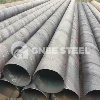
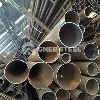
1. Core Identity: ASTM A335 Grade P91
When you see "K51545 Seamless Steel Pipe," it is almost always referring to pipe that conforms to ASTM A335 / A335M - Standard Specification for Seamless Ferritic Alloy-Steel Pipe for High-Temperature ServiceGrade P91.
The pipe is manufactured without a welded seam, making it stronger and more reliable for high-pressure applications.
Ferritic Alloy-Steel: This refers to the microstructure of the steel. P91 is a martensitic steel (a specific type of ferritic structure achieved by heat treatment), known for its strength and creep resistance.
High-Temperature Service: This is the primary purpose of P91 pipe.
2. Chemical Composition
The "P91" and "K51545" designations require a very specific chemical composition to achieve its properties. Key elements include:
| 0.08 - 0.12 | ||
| 8.00 - 9.50 | ||
| 0.85 - 1.05 | ||
| 0.18 - 0.25 | ||
| 0.06 - 0.10 | ||
| <= 0.40 | ||
| 0.03 - 0.07 | ||
| 0.20 - 0.50 | ||
| 0.30 - 0.60 |
3. Key Mechanical Properties
The pipe must meet specific mechanical property requirements after heat treatment (normalizing and tempering).
>= 585 MPa (85,000 psi)
>= 415 MPa (60,000 psi)
>= 20% (indicates good ductility)
4. Primary Applications
K51545 (P91) pipe is used in critical, high-stress environments, primarily in:
High-pressure steam lines in fossil fuel power plants (both main steam and hot reheat lines). It allows for higher operating temperatures and pressures, leading to greater plant efficiency.
In refineries and chemical plants for piping systems that handle high-temperature fluids and gases.
For high-temperature furnace components and heat exchangers.
5. Advantages of Using K51545 / P91 Pipe
It can withstand mechanical stress at very high temperatures (up to ~600℃ / 1112℃F) over long periods without deforming. This is its most critical advantage.
The high Chromium content forms a protective layer that resists scaling (oxidation) at high temperatures.
Can withstand cycles of heating and cooling without cracking.
Allows for the design of thinner pipe walls compared to lower-grade alloys (like P22), reducing weight and material cost.
6. Important Considerations and Challenges
P91 is notoriously more difficult to weld than carbon steel. It requires:
Strict pre-heating procedures.
Specific filler metals (e.g., ER90S-B9 for TIG, E9015-B9 for stick).
Precise control of interpass temperature.
A mandatory Post Weld Heat Treatment (PWHT) to restore the correct microstructure and toughness in the weld zone. Improper welding can lead to premature failure.
It is significantly more expensive than carbon steels (like A106 B) due to its complex alloy content and manufacturing process.
| Description for K51545 Seamless Steel Pipe | |
|---|---|
| ASTM A335 P91 Pipe | |
| Seamless, Ferritic Alloy-Steel | |
| Up to ~600℃ (1112℃F) | |
| Chromium (9%), Molybdenum (1%), Vanadium, Niobium | |
In conclusion, when a supplier or a project specifies "K51545 Seamless Steel Pipe," they are requesting a high-performance alloy steel pipe (ASTM A335 P91) designed for critical, high-temperature, and high-pressure applications, primarily in the power generation industry. Always ensure the material is supplied with the proper certifications (mill test certificates) to verify its compliance with the ASTM A335 standard.